




Search your Topic HERE....

Showing posts with label Banking Awareness. Show all posts

November 28, 2020

Lakshmi Vilas Bank is now DBS Bank (India)

Leave a Comment

Debt ridden Lakshmi Vilas Bank has became DBS India Bank due to it's merger with  Singapore's DBS Bank.  The Reserve Bank of India had announced yesterday (27th November 2020) as the effective date of merger for the 94-year old Tamil Nadu-based bank with DBS Bank India Ltd (DBIL). Earlier, the Union Cabinet headed by Prime Minister Narendra Modi has approved the Scheme of Amalagamation of LVB. 

On 17 November 2020, Reserve Bank of India instructed Lakshmi Vilas Bank (LVB) to be merged with DBS India after LVB having placed under moratorium for 30 days due to a "serious deterioration" in the company's financial position. RBI also issued a notification vide which it declared that the financial


position of Lakshmi Vilas Bank is not sufficient to pay off its depositors and a month moratorium was announced under which depositors are able to withdraw a limited amount of money. 

RBI presented a draft amalgamation scheme of Lakshmi Vilas Bank with DBS Bank India; the merger would result in a subsequent write-off of paid-up share capital and delisting of Lakshmi Vilas Bank from all stock exchanges. All the branches of LVB will now function as branches of DBIL.

About Lakshmi Vilas Bank

The Lakshmi Vila Bank Ltd was an Indian Private Sector lender established by a group of seven businessmen of Karur under the leadership of Shri V.S.N. Ramalinga Chettiar in 3 November 1926 under the Indian Companies Act, 1913. As of November 2020, the bank has 566 branches in 19 states and 1 union territory.
  • Headquarters :  Chennai (Tamil Nadu)
  • MD & CEO : Subramanian Sundar

About DBS Bank

DBS Bank Ltd is a Singaporean multinational banking and financial services corporation headquartered in Marina Bay, Singapore. It was established by the government of Singapore on 16 July 1968 with the name The Development Bank of Singapore Limited. Later it was named as DBS Bank Ltd on 21st July 2003 after gaining the status of global bank.  Headquartered in the commercial capital of Mumbai, DBS India operates via a network of 33 bank branches across 22 cities in India.

sponsored links
Read More...

June 01, 2020

Govt launches PM SVANIDHI scheme to provide affordable loan to Street Vendors

Leave a Comment
To provide affordable loan to street vendors, the Housing and Urban Affairs Ministry of Indian Government today announced a new Micro-Credit Facility Scheme titled PM SVANIDHI. It is an acronym for Pradhan Mantri Street Vendor’s Atmanirbhar Nidhi. The scheme is aimed at enabling the street vendors to resume their livelihoods that have been adversely affected due to COVID-19 lockdown. The scheme has been launched in pursuance of the announcement made by Finance Minister Nirmala Sitharaman last month. Street vendors play significant role in ensuring availability of the goods and services at affordable rates at the door-step of the city dwellers.

The scheme targets to benefit over 50 lakh street vendors, who had been vending on or before 24th March this year, in urban areas. The duration of the scheme is till March 2022. The street vendors belonging to the surrounding peri-urban or rural areas are being included as beneficiaries under the urban livelihoods programme for the first time.

With PM SVANIDHI, the vendors can avail a working capital loan of upto 10,000 rupees, which is repayable in monthly instalments in the tenure of one year. On timely and early repayment of the loan, an interest subsidy at the rate of seven per cent per annum will be credited to the bank accounts of beneficiaries through Direct Benefit Transfer on six monthly basis.

If the vendor will repays the instalments in time or earlier, they will develop his credible credit score that makes him eligible for higher amount of term loan to 20 thousand rupees and so on. Urban Local Bodies will play pivotal role in the implementation of the scheme. The lending institutions under the Scheme include Scheduled Commercial Banks, Regional Rural Banks, Small Finance Banks, Cooperative Banks, NBFCs, Micro Finance institutions and Self Help Group banks.

In order to ensure fast implementation of the scheme with transparency, a digital platform with web portal and mobile app is being developed to administer the scheme with end-to-end solution. The IT platform will also help in integrating the vendors into the formal financial system.

sponsored links
Read More...

May 22, 2020

RBI cuts Repo Rate by 40 basis points to 4% : Highlights

Leave a Comment
The Monetary Policy Committee of the Reserve Bank of India (RBI) headed by Governor Shaktikanta Das has cut the Repo rate by 40 basis points to 4% from 4.40%.  Repo rate is the rate at which banks borrow from the RBI. RBI last reduced the repo rate by 75 bps on 22nd March 2020 as the lockdown started. The Reverse repo rate is now at 3.35% and the Bank rate stands reduced to 4.25%. The MPC was forced to meet ahead of its 3-5 June scheduled meeting as liquidity continued to be tight in the money market, despite the central banks' previous steps of cutting interest rates and various policy measures. Here are the major highlights of Today's RBI Governor Press Conference.

  • Repo rate cut by 40 basis points
  • Reverse Repo gets adjusted to 3.35 percent.
  • Loan moratorium extended for 3 months
  • Headline inflation could stay firm in first half of 2020, but soften thereafter. If inflation trajectory evolves as expected, space will open up for more rate cuts.
  • India GDP growth in 2020-21 is estimated to remain in negative territory.
  • Regulatory measures to support exports, imports, states.
  • Term loan moratorium extension for another three months till August 31.
  • Accumulated interest for moratorium period can be converted into a term loan. It does not have to be repaid immediately after moratorium ends
  • Group exposure limit for lenders increased to 30 percent from 25 percent
  • Note : 1 bps is one hundredth of a percentage point.

sponsored links
Read More...

May 19, 2020

Attackers target Co-operative Banks using Covid 19 Trojan Malware

Leave a Comment
Researchers at Seqrite, the enterprise arm of IT security firm Quick Heal Technologies, have warned that the attackers have launched a Trojan Malware campaign titled Adwind Java Remote Access Trojan (RAT) Campaign to target Co-Operative Banks in India.  If attackers are successful, they can take over the victim’s device to steal sensitive data like SWIFT logins and customer details and move laterally to launch large scale cyberattacks and financial frauds.

What is Adwind Java Remote Access Trojan (RAT) campaign and How they Hack Bank's Computers ?

Attackers are sending phishing emails using COVID-19 as a decoy. Those emails claiming to be from the Reserve Bank of India (RBI) or any other Nationalised bank with the title consisting "COVID-19 guidelines or a Financial Transaction" with an attachment zip file containing a JAR based malware. The malware can take over users' devices, steal their information and carry out financial fraud.  The JAR based malware is a Remote Access Trojan that can run on any machine which has Java runtime enabled and hence it can impact a variety of endpoints, irrespective of their base operating system.

Once the Remote Access Trojan (RAT) is installed, the attacker can take over the victim’s device, send commands from a remote machine, and spread laterally in the network. In addition, this malware can also log keystrokes, capture screenshots, download additional payloads, and extract sensitive user information, Seqrite said, adding that such attack campaigns can effectively jeopardize the privacy and security of sensitive data at the co-operative banks and result in large scale attacks and financial frauds.

How to Prevent These Malware Attacks ?

To prevent such attacks, users need to exercise ample caution and avoid opening attachments and clicking on web links in unsolicited emails.  Banks should also keep their operating systems updated and have a full-fledged security solution installed on all the devices. They need to check the email of the sender properly (whether it is from the official sender who claims to be) before clicking on them.

sponsored links
Read More...

May 13, 2020

Atmanirbhar Bharat : Indian Govt's measures to support Indian Economy against COVID-19 with Rs 20 lakh crore package

Leave a Comment
Prime Minister Narendra Modi yesterday announced a Special economic and comprehensive package of Rs 20 lakh crores - equivalent to 10% of India’s GDP amid the coronavirus pandemic. He gave a clarion call for आत्मनिर्भर भारत अभियान or Self-Reliant India Movement.  He also outlined 5 pillars of Aatmanirbhar Bharat :
  1. Economy
  2. Infrastructure
  3. System
  4. Vibrant Demography 
  5. Demand
During the press conference today, Finance Minister Nirmala Sitharaman announced that the definition of MSMEs has been revised. Investment limit has been revised upwards and additional criteria of turnover has been introduced. Further, the distinction between manufacturing and service sector has been eliminated.

The investment limit of ₹25 lakh for micro units has been increased to ₹1 crore. To provide more funds at the disposal of taxpayers, the Government has also reduced TDS rates for non-salaried payments and TCS rates by 25% till March 31, 2021.  Due date of all income tax returns for the Financial Year 2019-20 will be extended from July 31, 2020 and October 31, 2020 to November 30, 2020. Furthermore, tax audit getting barred on September 30, 2020 has been extended to October 31, 2020. Date of those assessments getting barred on March 31, 2021 will be extended to September 30, 2021. 

Sitharaman announced a Special Liquidity Scheme worth ₹30,000 crore for NBFCs, HFCs and MFIs as they have been struggling to raise capital amid COVID-19. Here are some important measures taken by government for relief and credit support related to businesses, especially MSMEs to support Indian Economy’s fight against COVID-19
  • Due Dates for various tax relatedcompliances extended
  • EPF Contribution to be reduced for Employers and Employees for 3 months to 10% from 12% for all establishments covered by EPFO for next 3 months
  • Extending the Employees Provident Fund Support for business and organised workers for another 3 months for salary months of June, July and August 2020
  • New Definition of MSME and other Measures for MSME
  • No Global tenders for Government tenders of uptoRs 200 crore
  • Reduction in Rates of ‘Tax Deduction at Source’ and ‘Tax Collected at Source” by 25% for the remaining period of FY 20-21
  • Relief to Contractors given by extension of up to six months for completion of contractual obligations, including in respect of EPC and concession agreements
  • Relief to Real Estate Projects the registration and completion date for all registered projects will be extended up to six months.
  • Rs 20,000 crore Subordinate Debt for Stressed MSMEs
  • Rs 3 lakh crore Emergency Working Capital Facility for Businesses, including MSMEs
  • Rs 50,000 crore equity infusion through MSME Fund of Funds
  • Rs 90,000 crore Liquidity Injection for DISCOMs
  • Rs. 30,000 crore Special Liquidity Scheme for NBFC/HFC/MFIs
  • Rs. 45,000 crore Partial credit guarantee Scheme 2.0 for Liabilities of NBFCs/MFIs
  • Tax relief to business as pending income tax refunds to charitable trusts and non-corporate businesses and professions to be issued immediately
Download the Presentation made by Finance Minister under Aatmanirbhar Bharat Abhiyaan to support Indian economy in fight against COVID-19 from HERE

sponsored links
Read More...

April 25, 2020

Govt declares Banking Industry as Public Utility Service : What does this mean ?

Leave a Comment
Amid the Covid 19 pandemic which has significantly impacted economic activities, the Indian Government today declared the Banking Industry as a Public Utility Service for 6 months till 21st October 2020. The government made this move under the provisions of the Industrial Disputes Act.

What is Industrial Disputes Act ?

The Industrial Disputes Act, which was enacted on 11th March 1947 and came into force on 1st April 1947 has made provision for the investigation and settlement of industrial disputes and for certain other purposes. It regulates Indian Labour Law so far as that concerns trade unions as well as Individual workman employed in any Industry within the territory of Indian mainland.

What does this mean ?

Bringing banking services under the provisions of Industrial Disputes Act means that the banking sector would not see any strikes by employees or officers during the operation of the law starting from April 21. There are over a dozen employees and officers unions in the banking sector. These unions enjoy a considerable say in wage negotiations, which the IBA deals with every 5 years. There are several issues on which the bank unions don’t agree with the decisions of the government. The latest is the merger of several banks.  

The notification was issued by the labour ministry and the circular has been addressed to the RBI Governor, SBI Chairman, Managing Directors and CEOs of nationalized banks, and the CEO of Indian Banks’ Association (IBA).


sponsored links
Read More...

April 17, 2020

Corona (Covid-19) Effect : RBI cuts Reverse Repo Rate by 25 bps

Leave a Comment
In the wake of Corona virus (Covid 19) crisis and the subsequent countrywide lockdown in India, the Reserve Bank of India (RBI) governor Shaktikanta Das today announed the reduction in reverse repo rate by 25 basis points from 4 per cent to 3.75 per cent. This move will help in injecting liquidity in financial markets. However, the repo rate remains unchanged.  Addressing the media, Das said on April 14, International Monetary Fund released its global growth projections, revealing that in 2020, the global economy is expected to plunge into the worst recession since 'The Great Depression'.

Here are the Major Highlights of the Reserve Bank Governor Shaktikanta Das's address to the media today
  • 50% of the funds in TLTRO 2,0 is for small and medium-sized NBFCs
  • 60% of ways and means advances allowed to states until September 30, 2020
  • A special Rs 50,000 crore refinance facility for Nabard (RS 25,000 crore), Sidbi (Rs 15,000 crore) and NHB (Rs 10,000 crore)
  • ATMs have worked at 91% capacity during this period.
  • Banks will need to maintain additional provisioning of 10 per cent on standstill accounts
  • Banks won't announce dividends until further notice
  • Every data on monsoon, sowing, fertilisers bode well for agri and rural outlook but situation is sombre in other industrial sectors.
  • India expected to stage a smart recovery to grow at pre-coronavirus pace of 7% in FY21, according to the IMF
  • India is one of the few countries projected to hang on to - perhaps tenuously - 1.9% GDP growth, according to the IMF.
  • LCR requirement brought down from 100% to 80% with immediate effect. LCR requirement to be restored to the previous level in a phased manner
  • Liquidity management: Will undertake TLTRO 2.0 operations. LTRO of Rs 50,000 cr to begin with in many tranches for NBFCs
  • Loans given by NBFCs to real estate companies to get similar benefit as given by scheduled commercial banks
  • Macroeconomic landscape has deteriorated since March 27, 2020.
  • NBFCs allowed to grant relaxed NPA classification to their borrowers
  • NBFCs' loans to delayed commercial real estate projects can be extended by a year without restructuring
  • No downtime has been observed for internet or mobile banking.
  • NPA classifications will exclude the three-month moratorium period till May-end
  • Since March 27, surplus liquidity has increased sharply in the banking system.
  • The global economy is going through the worst phase since the Great Depression.
  • The impact of Covid-19 has not been captured in recent IIP data.
  • The RBI has taken several steps to ensure normal functioning of banks.
Note : In the last meeting on March 27, the RBI had announced a massive 90 bps cut in reverse repo rate, the rate at which the RBI borrows money from banks by lending securities, to ensure surplus liquidity in the system. The repo rate was reduced to a 15-year-low of 4.40 per cent and was also the steepest cut since October 2004.

New Policy Rates and Reserve Ratios of RBI 2020 (as on 17th April)

  • Repo Rate : 4.40%
  • Reverse Repo Rate : 3.75%
  • Marginal Standing Facility (MSF) Rate : 4.65%
  • Bank Rate : 4.65%
  • CRR : 3%
  • SLR : 18%
sponsored links
Read More...

February 01, 2020

Union Budget 2020 Highlights (Pdf Download)

Leave a Comment
Finance Minister Nirmala Sitharaman today (1st February 2020) presented the Union Budget 2020-21 in 'bahi khata'. This is her 2nd budget in 8 months. Before presenting the budget, she paid homage to her predecessor Arun Jaitley and described him as the 'Architect of GST'. She said GST has helped in formalisation of the economy and an average household saves 4% on monthly spending after implementation of GST. Sitharaman added that GST has helped in vanishing 'inspector raj' of the past.
Read More...

January 31, 2020

Economic Survey 2020 Highlights Quick Review (Pdf Download)

Leave a Comment
Finance Minister Nirmala Sitharaman today (31st January 2020) tabled the Economic Survey 2020. The economic survey is an annual document of the finance ministry, which provides comprehensive details about the state of the Indian economy, and reviews the economic progress made and issues faced in the past year.

The 2 volume survey ( Volume I and Volume II), which was printed in LAVENDER Color (same as the colour of the new 100 rupee note), was prepared by Krishnamurthy Subramanian (Chief Economic Adviser)

Stating that the Indian Economy has bottomed out, the economic survey 2020 has projected India's economic growth at 6 per cent to 6.5 per cent in the next financial year. The government has estimated growth at 5% for 2019-20, which would be lowest in 11 years. 

The Theme of Economic Survey 2020 is "Enable markets, promote 'pro-business' policies and strengthen 'trust' in the economy". 

The survey suggests framework to enable ethical wealth creation in India, which will in turn propel growth and help India become a $5 trillion economy by 2025.

This survey gives a clear picture of the country's economic health and a sneak peek into the Budget 2020 to be by our finance minister tomorrow. Here are the major highlights of Economic Survey 2020. You can download PDF Version of these highlights from HERE.

Quick Review of Economic Survey 2020

  • Prepared by : Krishnamurthy Subramanian 
  • Color : Lavender
  • Theme : Enable markets, promote 'pro-business' policies and strengthen 'trust' in the economy.
  • India’s dominance as global economic power for three-fourths of economic history manifests by design.
  • Kautilya’s Arthashastra postulates the role of prices in an economy (Spengler, 1971).
  • Historically, Indian economy relied on the invisible hand of the market with the support of the hand of trust :
    • Invisible hand of the market reflected in openness in economic transactions.
    • Hand of trust appealed to ethical and philosophical dimensions.
  • Post-liberalisation, Indian economy supports both pillars of the economic model advocated in our traditionalthinking.
  • The survey illustrates enormous benefits accruing from enabling the invisible hand of the market.
  • Exponential rise in India’s GDP and GDP per capita post-liberalisation coincides with wealth generation.
  • Survey shows that the liberalized sectors grew significantly faster than the closed ones.
  • Need for the hand of trust to complement the invisible hand, illustrated by financial sector performanceduring 2011-13.
  • Survey posits that India’s aspiration to become a $5 trillion economy depends critically on : 
    • Strengthening the invisible hand of the market.
    • Supporting it with the hand of trust.
  • Strengthening the invisible hand by promoting pro-business policies to : 
    • Provide equal opportunities for new entrants.
    • Enable fair competition and ease doing business.
    • Eliminate policies unnecessarily undermining markets through government intervention.
    • Enable trade for job creation.
    • Efficiently scale up the banking sector.
  • Introducing the idea of trust as a public good, which gets enhanced with greater use.
  • The survey suggests that  policies must  empower transparency and  effective enforcement using  data  and technology.

Key Highlights of Economic Survey 2020

  • Economic Survey 2020 talked about a new phrase called ‘Thalinomics’ which is the economy of a plate of food in India. It says that food plates are becoming more affordable in India now indicated improvement in the welfare of the common man. Survey said that Thali price moderation led to Rs 10,887 gain per household per year. The survey claimed that a whopping 2.62 crore jobs were created in India during 2011-12 to 2017-18.
  • India's economic growth is expected to "strongly rebound" to 6-6.5 per cent in 2020-21 from 5 per cent estimated in the current fiscal. The Survey said there are tentative signs of bottoming out of slowdown in manufacturing activity and global trade, which will have a positive impact on growth in the next fiscal.
  • Considering the urgent priority of the government to revive growth in the economy, the fiscal deficit target may have to be relaxed for the current year, the survey said.The Economic Survey 2019-20 has proposed India can create well-paid four crore jobs by 2025 and eight crore by 2030 by integrating “assemble in India for the world” into government’s Make in India initiative and exporting network products that can give substantial push to India’s target of becoming a $5 trillion economy.India's GDP growth is neither overestimated nor underestimated and the concerns on data are unfounded. It said that cross-country comparisons are fraught with risks of incorrect inference due to various confounding factors that stem from such inherent differences.
  • Government interventions like debt waiver or food subsidies end up creating distortions in the functioning of the free market. The Survey says that debt waiver scehems disrupt credit culture and disrupt formal credit flow to the very farmers it aims to benefit.
  • The country needed to spend $1.4 trillion on infrastructure to remove the constraints in growth, as power shortages, inadequate transport and poor connectivity affects overall growth performance, and to achieve a GDP of $5 trillion by 2024-25.
  • India's balance of payments position improved to USD 433.7 billion by September 2019 from USD 412.9 billion of forex reserves in March 2019, says Economic survey 2019-20. India's foreign reserves are comfortably placed at USD 461.2 billion as on 10th January 2020. Further, the external debt levels remained low at 20.1 per cent of GDP by the end of September 2019.
  • The Economic Survey has pinned its hope on uptick in growth of cumulative GST collections in October 2019 and November-December to contain fiscal deficit at the budgeted 3.3 per cent for FY2020.
  • The Survey suggested providing ESOPs to public sector bank employees to enable them to become owners in the banks. Employee stock ownership plans (ESOPs) will incentivise the bank employees to embrace risk-taking and innovation continually, it said.
  • It takes more documents to open a restaurant in Delhi as compared to documents needed for a license to procure new arms and major fireworks, says the Economic Survey for 2019-20.
  • Funding of the Rs 102 lakh crore National infrastructure pipeline recently unveiled by the Indian government “would be a challenge”, the Economic Survey for 2019-20 said.
  • The survey cited a new selloff mode. In the model, the government can transfer its stake in the listed CPSEs to a separate corporate entity which would be managed by an independent board and would be mandated to divest the government stake in these CPSEs over a period of time.
  • As per the pre-Budget survey, services exports have outperformed goods exports in the recent years, due to which India's share in the world's commercial services exports has risen steadily over the past decade to reach 3.5 per cent in 2018, twice the share in world's merchandise exports at 1.7 per cent.
  • Indian companies garnered nearly Rs 74,000 crore through public issuance of equity and debt during April-December this fiscal, a 66 per cent jump from the preceding financial year, with rights issue emerging as the most preferred route for financing business needs. Companies had raised Rs 44,355 crore in the April-December period of 2018-19.
  • In India, affordability of vegetarian 'thalis' improved more compared to non-vegetarian 'thalis' in last 13 years. Affordability of vegetarian 'thalis' improved by 29 per cent while that for non-vegetarian 'thalis' by 18 per cent from 2006-07 to 2019-20. As a result, an average household of five individuals that eats two vegetarian 'thalis' a day, gained around Rs 10,887, on average per year, while a non-vegetarian household gained Rs 11,787, on average per year.
  • The Survey pointed out high drop out rates at various levels of schooling and lack of affordability in higher education as areas of concern. The Survey emphasised that Samagra Shiksha 2018-19, was launched to envisage school education as a continuation from pre-school to senior secondary level to provide access to education to all.
  • According to the Survey, foreign tourist arrivals to India on e-visas, which are available for 169 countries, have increased from 4.45 lakh in 2015 to 23.69 lakh in 2018 and stood at 21.75 lakh in January-October 2019, recording nearly 21 per cent year-on-year growth in the tourism sector.
  • India's mineral output has witnessed a notable turnaround on account of reform measures initiated by the government.
Read More...

October 09, 2019

List of Important Banking related Acts and years

Leave a Comment

List of Important Banking Related Acts and years

  • Banker’s Books Evidence Act -  1891
  • Banking Companies (Acquisition and Transfer of Undertaking) Act -  1969
  • Banking Companies (Legal Practitioners’ Clients’ Account) Act -  1949
  • Banking Companies (Period of Preservation of Records) Rules -  1985
  • Banking Companies (Regulation)Rules - 1985
  • Banking Regulation (Companies) Rules 1949
  • Banking Regulation (Companies) Rules -  1949
  • Banking Regulation Act -  1949
  • Chit Fund Act - 1982
  • Credit Information Companies (Rules & Regulation) Act - 2005
  • Debts Recovery Appellate Tribunal (Procedure) Rules - 1994
  • Factoring Act Rules -  2011
  • Foreign Contribution (Regulation) Act -  1976
  • Foreign Exchange Management Act -  1999
  • Indian Partnership Act -  1932
  • Indian Stamp Act -  1899
  • Indian Trusts Act -  1882
  • Industrial Development Bank (Transfer of Undertaking & Repeal) Act - 2003
  • Industrial Reconstruction Bank (Transfer of Undertaking & Appeal) Act - 1997
  • Limitation Act -  1963
  • NABARD Bonds Regulations — 1988
  • NABARD General Regulations 1982
  • Negotiable Instrument Act - 1881
  • Recovery of Debts due to Banks and Financial Institutions Act - 1993
  • Reserve Bank of India Act — 1934
  • SARFAESI (Central registry) Rules - 2011
  • Shipping Development Fund Committee (Abolition)Act - 1985
  • Sick Industrial Companies (Special Provisions)Act - 1985
  • SIDBI Act - 1988
  • SIDBI General Regulations -  1990
  • The Bankers’Books Evidence Act - 1891
  • The Banking Companies (Acquisition and Transfer of Undertakings) Act - 1970
  • The Banking Companies (Acquisition and Transfer of Undertakings) Act - 1980
  • The Banking Companies (Legal Practitioner Clients’ Accounts) Act - 1949
  • The Banking Ombudsman Scheme -  2006
  • The Banking Regulation Act - 1949
  • The Banking Regulation(Companies) Rules - 1949
  • The Deposit Insurance and Credit Guarantee Corporation Act - 1961
  • The Deposit Insurance and Credit Guarantee Corporation Act - 1961(DICGC)
  • The Export-Import Bank of India Act - 1981
  • The Industrial Disputes (Banking and Insurance Companies) Act - 1949
  • The Industrial Disputes (Banking Companies) Decision Act - 1955
  • The Industrial Finance Corporation (Transfer of Undertakings and Repeal) Act - 1993
  • The Industrial Finance Corporation of India Act - 1948
  • The National Bank for Agriculture and Rural Development Act - 1981
  • The National Housing Bank Act - 1987
  • The Nationalised Banks (Management and Misc. Provisions)Scheme - 1970
  • The Regional Rural Banks Act - 1976
  • The Reserve Bank of India (Amendment and Misc. Provisions) Act - 1953
  • The ReserveBank of India Act - 1934
  • The Securitisation and Reconstruction of Financial Assets and Enforcement of Security Interest Act - (SARFASI-2002)
  • The Special Court (trial of Offences relating to Transactions in Securities) Act - 1992
  • The State Bank of India (Subsidiary Banks) Act-1959
  • The State Bank of India Act - 1955
  • The State Financial Corporations Act - 1951
  • The Subsidiary Banks General Regulation - 1959

sponsored links
Read More...

October 04, 2019

RBI Cuts Repo Rate by 25 bps, Reverse Repo Rate at 4.90% - Monetary Policy Review 2019 highlights

Leave a Comment
In it's 4th bimonthly policy review, the 6 member Monetary Policy Committee (MPC) of the Reserve Bank of India  (RBI) headed by RBI Governor Shaktikanta Das, today cut the Repo Rate by 25 basis points to 5.15 per cent.  This is the 5th straight rate cut from the RBI. The Reverse repo rate stood at 4.90 per cent. Here are the major highlights of RBI's 4th bimonthly policy review 2019.

RBI Monetary Policy Review Highlights 2019

  • RBI's monetary policy committee decided to cut repo rates by 25 basis points to 5.15 percent.
  • The reverse repo rate under the LAF stands reduced to 4.90 per cent
  • The marginal standing facility (MSF) rate and the Bank Rate to 5.40 per cent.
  • The MPC also decided to continue with an accommodative stance as long as it is necessary to revive growth, while ensuring that inflation remains within the target.
  • Indian shares rose today ahead of a likely interest rate cut by the RBI in the backdrop of slowing economic growth, with beaten-down banking stocks leading gains.
  • The minutes of the MPC’s meeting will be published by October 18, 2019.
  • In the August policy, all members of the MPC (Monetary Policy Committee) unanimously voted to reduce the policy repo rate and to maintain the accommodative stance of the monetary policy.
  • RBI Governor Shaktikanta Das had justified the RBI`s unconventional move saying, "the economy needed a larger push" and a reduction in the policy repo rate by the conventional 25bps would be inadequate.
  • The next meeting of the Monetary Policy Committee (MPC) is scheduled during December 3-5, 2019.
sponsored links
Read More...

August 07, 2019

RBI cuts Repo Rate for 4th Time : Monetary Policy Highlights 2019

Leave a Comment
The 6 member Monetary Policy Committee of the Reserve Bank of India (RBI) has delivered its 4th successive interest rate cut to support a slowing economy. The benchmark Repo rate, which is the key interest rate at which it lends short-term funds to commercial banks, now was lowered by 35 bps to a 9 year low of 5.4%.

After the repo rate cut by the Reserve Bank of India, equated monthly installments (EMI) for home and other loan borrowers are set to come down. Reverse repo rate stood at 5.15 per cent. The RBI also lowered the GDP growth rate for 2019-20 lower to 6.9%, as compared to earlier estimate of 7%. Finance Minister Nirmala Sitharaman had called for "a significant rate cut" as it "would do a lot of good for the country".

Here are the major highlights of the 3rd Monetary Policy Review of the Reserve Bank of India (RBI) 2019

RBI Monetary Policy Highlights 2019

  • The Reserve Bank of India cuts key interest rate (repo) by an unusual 35 basis points (0.35 percentage points) to 5.40 per cent.
  • Reverse repo rate has been revised to 5.15 per cent.
  • The marginal standing facility (MSF) rate and bank rate stands at 5.65 per cent.
  • Maintains the accommodative policy stance.
  • Cuts GDP forecast to 6.9 per cent for the current fiscal from 7 per cent in June policy.
  • Keeps retail inflation forecast within target of 3.5-3.7 per cent for second half of 2019-20.
  • Four members voted for cut of 35 basis points in rate; two members voted for 25 basis points rate cut.
  • Boosting aggregate demand, private investment assume highest priority.
  • Next monetary policy statement on October 4.
Note : When the RBI cuts rates, banks are expected to pass on the benefit to consumers and reduce interest rates on home, auto, personal or other loans which may result in lower EMIs (equated monthly instalments).

sponsored links
Read More...

July 26, 2019

Heads of Financial Bodies India 2019

Leave a Comment
Hi I am Archana Singh Suryavanshi. I would like to contribute a small post in Gr8AmbitionZ.com. All of you know, how important are the names of heads (Directors, MD & CEOs etc) in Banking Exams. You people can easily get the names of Bank Managing Directors and Chief Executive Officers. But it somewhat difficult to get the names of people who are heading various financial bodies in India. So I compiled a small list with the names of important personalities who are leading important financial bodies in India. I made this list by keeping the names as of today (26th July 2019). I will try to add / change if I come across any. Happy Reading :)

Important Indian Financial Bodies and Heads 2019

  • Governor, Reserve Bank of India (RBI) - Shaktikanta Das
  • CEO and Managing Director, Industrial Finance Corporation of India (IFCI Ltd) - Emandi Sankara
  • CEO and Managing Director, National Housing Bank (NHB) - Sriram Kalyanaraman
  • Chairman & MD, Gas Authority of India Limited (GAIL) – B. C. Tripathi
  • Chairman & MD, Oil India Limited - Utpal Bora
  • Chairman and Managing Director, Export-Import Bank of India (EXIM Bank) - Yaduvendra Mathur
  • Chairman, 15th Finance Commission of India - N. K. Singh
  • Chairman, 7th Pay Commission - Ashok Kumar Mathur
  • Chairman, Bombay Stock Exchange (BSE) - Sethuratnam Ravi
  • Chairman, Company Law Board - Mahesh Kumar Mittal
  • Chairman, Indian Oil Corporation Limited (IOCL) - Sanjiv Singh
  • Chairman, Industrial Development Bank of India (IDBI) - Mahesh Kumar Jain
  • Chairman, Insurance Regulatory and Development Authority of India (IRDAI) - Subhash Chandra Khuntia
  • Chairman, Life Insurance Corporation of India(LIC) - M.R.Kumar
  • Chairman, National Bank for Agriculture and Rural Development (NABARD) - Harsh Kumar Bhanwala
  • Chairman, National Statistical Commission (NSC) - Radha Binod Barman
  • Chairman, National Stock Exchange (NSE) - Ashok Chawla
  • Chairman, Pension Fund Regulatory and Development Authority (PFRDA) - Hemant G.
  • Chairman, Securities and Exchange Board of India (SEBI) - Ajay Tyagi
  • Chairman, Small Industries Development Bank of India (SIDBI) - Muhammad Mustafa
  • Chairman, Telecom Regulatory Authority of India (TRAI) - Ram Sevak Sharma
  • Chairperson, Central Board of Secondary Education (CBSE) - Anita Karwal
  • Chairperson, State Bank of India (SBI) - Rajnish Kumar
  • CMD, Oil and Natural Gas Corporation (ONGC) - Shashi Shanker
  • Director General, Archaeological Survey of India (ASI) - Rakesh Tewari
  • Director, Enforcement Directorate (ED) – Karnal Singh
  • President, Associated Chambers of Commerce and Industry of India (ASSOCHAM) - Sandeep Jajodia
  • President, Confederation of Indian Industry (CII) - Rakesh Bharti Mittal
  • President, Federation of Indian Chambers of Commerce and Industry (FICCI) - Pankaj Patel 
sponsored links
Read More...

July 23, 2019

List of Loan Agreements signed by India with World Bank, ADB, Exim Bank & AIIB in 2019

Leave a Comment
Hi I am Priya Dhiman. I am sharing the list of Loan Agreements signed by India with various top banks of the world like Asian Development Bank (ADB), World Bank, Asian Infrastructure Investment Bank (AIIB) and Exim Bank. This list will be very helpful for your upcoming competitive exams, especially banking exams. Happy Reading :)

List of Loan Agreements 2019

  • Asian Development Bank (ADB) - $26 Million to provide additional financing for improving drainage infrastructure in Dibrugarh in Assam.
  • Asian Development Bank (ADB) - 235mn (1650cr ) for infrastructure projects in Tripura
  • Asian Development Bank (ADB) - Rs 1,650 crore to develop infrastructure in seven district headquarter towns of Tripura
  • Asian Development Bank (ADB) - USD 926 Million to operationalize two lines for the Mumbai Metro Rail System.
  • Asian Development Bank (ADB) -350mn for Chattisgarh State Highway
  • Asian Development Bank (ADB) -750mn for Indian railway track electrification
  • Asian Infrastructure Investment Bank (AIIB) - US$ 455 Million Loan to improve Rural Connectivity in State of Andhra Pradesh
  • Exim Bank -124mn for Papua new guinea & Senegal for health and infrastructure
  • Exim Bank- 245 mn for Mozambique &Ghana for agricultural and health reform
  • World Bank -  $250-million for the National Rural Economic Transformation Project (NRETP)
  • World Bank - $ 40 million for Water Supply Infrastructure in Shimla
  • World Bank - $328 million (Rs 2,200 Crore) for a project that aims to strengthen the Healthcare of Andhra Pradesh state.
  • World Bank - US$ 250 Million for Rajasthan State Highways Development Project
  • World Bank - US$ 400 Million to Eliminate Tuberculosis from India
  • World Bank - USD 137 Million under the Dam Rehabilitation and Improvement Project (DRIP)
  • World Bank - USD 147 Million Loan for Jharkhand Municipal Development Project
  • World Bank - USD 25.2 Million to support Chhattisgarh Public Financial Management and Accountability Program.
  • World Bank - USD 31.58 Million for the Uttarakhand Public Financial Management Strengthening Project  
  • World Bank - USD 328 Million for Improved Health Services in Andhra Pradesh
  • World Bank - USD 96 Million to provide additional funds to the State of Uttarakhand in its post-disaster recovery plans,
  • World Bank -250mn for Kerala resilient program 
sponsored links
Read More...

July 16, 2019

Meet Andhra Bank's new Chatbot - 'ABHi'

Leave a Comment
To help it's customers, Indian Public Sector Lender Andhra Bank today launched a Chatbot named 'ABHi'. The Managing Director (MD) and Chief Executive Officer (CEO)  of Andhra Bank, J Packrisamy launched ABHi at a function held at Bank's Head Office in Hyderabad today.

The word 'AB' is the acronym of 'Andhra Bank' and 'Hi' is a friendly greeting, hence the word 'ABHi'. This chatbot uses latest Artificial Intelligence (AI) and Natural Language Processing (NLP) algorithm to understand the customer query and fetch the relevant information from possible knowledgebase in a matter of milliseconds. 

With ABHi, customers will be able to get the information instantaneously 24x7, anytime they want. Customers can connect and know details from ABHi through website www.andhrabank.in over Mobile/Desktop browser, Facebook Messenger and over voice using Google Assistant. 

Customer can ask ABHi the following details :
  • Digital banking
  • Loans
  • Banking Services
  • Govt. Schemes
  • Insurance
  • Senior Citizen
  • RuPay Offers
  • Aadhaar Services
  • Payment Mode
  • Deposit/EMI Calculator
  • Lodge a customer complaint
  • Know nearest Branch / ATM on Google map
  • Recharge Prepaid mobile etc.,
'Andhra Bank has been proactively updating its technology and the chatbot-ABHi being the latest feather in the cap of Bank's technological advancement', Packrisamy said while launching the chatbot. 

sponsored links
Read More...

July 15, 2019

Union Budget 2019 : Allocations for Important Govt Schemes (Quick Review)

Leave a Comment
Hi friends, I am Varsha. I would like to share an important topic from Union Budget 2019. Below is the list of  Budgetary Allocations of some important Centrally Sponsored Schemes and Welfare Programmes. I compiled this list based on the latest Budget 2019-20 released by our Finance Minister Nirmala Sitaraman. This list will come handy for you in your upcoming Banking and Insurance exams. You can download the pdf version of Budget Outlay on Major Schemes from the link given below the posts. All the best.

Allocations for Important Govt Schemes in Union Budget 2019

  • Rashtriya Swasthya Bima Yojna - Rs. 6556 Crores
  • Blue Revolution - Rs. 560 Crores
  • Border Area Development Programme - Rs. 825 Crores
  • Deen Dayal Upadhyaya Gram Jyoti Yojna - Rs. 4066 Crores
  • Green Revolution - Rs. 12561 Crores
  • Integrated Child Development Services - Rs. 27584 Crores
  • Integrated Development of Tourist Circuits around specific themes (Swadesh Darshan) & PRASAD - Rs. 1106 Crores
  • Integrated Power Development Scheme - Rs. 5280 Crores
  • Jobs and Skill Development - Rs. 7260v
  • Mahatma Gandhi National Rural Employment Guarantee Scheme (MNREGA) - Rs. 60000 Crores
  • Mid-day Meal - Rs. 11000 Crores
  • National Education Mission - Rs. 38547 Crores
  • National Health Mission - Rs. 33651 Crores
  • National Livelihood Mission - Ajeevika - Rs. 9774 Crores
  • National Rural Drinking Water Mission - Rs. 10001 Crores
  • National Social Assistance Progam - Rs. 9200 Crores
  • Pradhan Mantri Awaas Yojana - Rs. 25853 Crores
  • Pradhan Mantri Gramin Digital Saksharta Abhiyan (PMGDISHA) - Rs. 518 Crores
  • Pradhan Mantri Krishi Sinchai Yojna - Rs. 9682 Crores
  • Prime Minister Employment Generation Programme (PMEGP) - Rs. 2327 Crores
  • Prime Minister Gram Sadak Yojana - Rs. 19000 Crores
  • Rashtriya Gram Swaraj Abhiyan (RGSA) - Rs. 822 Crores
  • Shyama Prasad Mukherjee Rurban Mission - Rs. 800 Crores
  • Swachh Bharat Mission - Rs. 12644 Crores
  • Urban Rejuvenation Mission: AMRUT and Smart Cities Mission - Rs. 13750 Crores
  • White Revolution - Rs. 2240 Crores
Note : Those people who wants to know the complete details about the budgetary allocations an download the full pdf version of Budget 2019 Outlay on Major Schemes from HERE.

Shared by Varsha Mishra 
sponsored links
Read More...

July 12, 2019

AP Budget 2019 Highlights - PDF Download (English & Telugu Versions)

Leave a Comment
Hello friends, I am Arun Kanth Duvvuri. A Group Aspirant from Andhra Pradesh. Today AP Finance Minsiter Buggana Rajendranath Reddy has introduced the state Budget for the year 2019-20 in the Legislative Assembly. This is his maiden budget and also the first budget of new Chief Minister Y. S. Jagan Mohan Reddy's government. The government has presented the budget with Rs 2,27,974 crores

As the Main Exams of Group 1, Group 2 and Panchayat Secretaries are on line and the state government is going to announce notifications for the recruitment of 40,000+ posts of village secrataries, AP Budget 2019-20 is very important for the competitive exam aspirants of AP. So here I am sharing the PDF Version of Andhra Pradesh Budget 2019 in both English and Telugu Languages. This will be very helpful for your preparation. Lastly I would like to thank team Gr8AmbitionZ for letting me help the fellow aspirants of Andhra Pradesh state. Good luck all. Happy Reading :)

Andhra Pradesh Budget 2019 Highlights

AP Budget 2019 in Numbers

  • Total Budget : Rs 2,27,974 crores.
  • Revenue deficit : Rs 1,778,52 crore
  • Budget Estimation : 19.32 percent incresed
  • Revenue Expenditure : Rs 1,80,475 crore

Allocations of AP Budget 2019 (English) :

  • Rs 1,163 crore for YSR crop insurance
  • Rs 1,912 cror to fisheries and dairy development department
  • Rs 100 crore for Brahmin Corporation
  • Rs 100 crore to Pulivendula Area Development Authority
  • Rs 100 crore to the Advocates Welfare Trust
  • Rs 1000 crore for APSRTC
  • Rs 11399 crore for medical and health care sector.
  • Rs 1140 crore for interest-free loans for Dwarka women
  • Rs 1150 crore for Agri Gold victims
  • Rs 14,412 crore for the welfare sector
  • Rs 1439 crore for the Planning Department
  • Rs 15,000 crore for the development of Dalits
  • Rs 15,746.58 crore for YSR Pension Kanuka
  • Rs 150 crore for smart cities
  • Rs 1500 crore for YSR housing scheme
  • Rs 1561 crore for the development of BC (Backward Classes)
  • Rs 1740 crore for YSR Arogyasri
  • Rs 191 crore for information and public relations (I&PR)
  • Rs 2,000 crore for natural disaster management
  • Rs 20,677 crore for agriculture and allied sectors
  • Rs 200 crore for free borewells under YSR Rythu Bharosa scheme
  • Rs 200 crore for seeds distribution to the farmers
  • Rs 234 crore of YSR grant to religious organizations
  • Rs 250 crore for Kadapa Steel Plant
  • Rs 3,000 crore for Price Stabilization Fund
  • Rs 3,750 crore for civil Supplies
  • Rs 32618 crore for Education Sector [highest priority ]
  • Rs 329 crore for has been allocated to sports and youth welfare department
  • Rs 3617 crore for the housing sector.
  • Rs 4,962.3 crore for Jagananna Vidya Deevena scheme
  • Rs 400 crore financial assistance to drivers who own autos
  • Rs 410 crore for welfare of fishermen
  • Rs 455.85 crore for Asha workers.
  • Rs 475 crore for aqua farmers' electricity subsidy
  • Rs 477 crore for Forest, Science, and Technology
  • Rs 4988 crore for tribal development
  • Rs 500 crore for the development of Capital city of Amaravati
  • Rs 6455 crore for Amma Vodi scheme
  • Rs 648 crore for Interest-free loans to urban SHGs
  • Rs 65 crore for the Capital Region Social Security Fund
  • Rs 73 crore for CM call center
  • Rs 77.67 crore for cultural affairs department
  • Rs 8,750 crore for YSR Rythu Bharosa scheme [investment support of Rs 12,500 will be provided every year in the month of May]
  • Rs. 1077 crore for mid-day meal scheme in schools
  • Rs. 92,050 crore for State Development Schemes
  • Rs.180 crore for municipal ward secretaries and Rs.180 crore for municipal ward volunteers
  • Rs.2,000 crore for Kapu welfare
  • Rs.500 crore for infrastructure development of schools and Rs 160 crore for school management grant.
  • Rs.700 crores for village secretaries and Rs.720 crores for grama volunteers

AP Budget 2019 Highlights Telugu Version

ఆంధ్రప్రదేశ్  బడ్జెట్ 2019-20 కీలక అంశాలు 

  • జీఎస్‌డీపీలో రెవెన్యూలోటు సుమారు 0.17శాతం .
  • రెవెన్యూలోటు రూ.1778.52కోట్లు.
  • ద్రవ్యలోటు సుమారు రూ.35,260.58కోట్లు
  • రెవెన్యూ వ్యయం రూ.1,80,475.94కోట్లు.
  • మూలధన వ్యయం రూ.32,293.39కోట్లు.
  • రైతులకు వడ్డీలేని రుణాల కింద రూ.100 కోట్లు
  • వ్యవసాయ యాంత్రీకరణ కింద రూ.100.05కోట్లు.
  • పాల సహకార సంఘాల అభివృద్ధికి రూ.100కోట్లు.
  • గిడ్డంగుల నిర్మాణానికి రూ.37.53కోట్లు.
  • గిడ్డంగులు, మౌలిక నిధి కింద రూ.200కోట్లు.
  • వైఎస్‌ఆర్‌ వ్యవసాయ ప్రయోగశాల కోసం రూ.109.28కోట్లు.
  • ఇంధన శాఖకు రూ.6,861.03కోట్లు.
  • పారిశ్రామిక ప్రోత్సాహకాల కోసం రూ.573.60కోట్లు.
  • పారిశ్రామిక మౌలిక కల్పన కింద రూ.250కోట్లు.
  • సూక్ష్మ, చిన్న, మధ్య తరహా పరిశ్రమల మౌలిక అభివృద్ధి వనరుల కోసం రూ.200కోట్లు.
  • పారిశ్రామిక కల్పన కింద రూ.250కోట్లు.
  • జగనన్న అమ్మ ఒడి పథకం కోసం రూ.6,455.80కోట్లు.
  • పాఠశాలల్లో మౌలిక సౌకర్యాల కల్పనకు రూ.1500కోట్లు.
  • మధ్యాహ్న భోజన పథకానికి రూ.1077కోట్లు.
  • వైఎస్‌ఆర్‌ పాఠశాలల నిర్వహణ గ్రాంటు రూ.160కోట్లు
  • అక్షయపాత్ర ఫౌండేషన్‌ వంటశాలల నిర్మాణానికి రూ.100కోట్లు.
  • రాష్ట్ర అభివృద్ధి పథకాల అంచనా వ్యయం రూ.92,050.05కోట్లు
  • ఎస్సీ సబ్‌ప్లాన్‌ కంపోనెంట్‌ కింద రూ.15,000కోట్లు.
  • ఎస్టీ సబ్‌ప్లాన్‌ కంపోనెంట్‌ కింద రూ.4988.52కోట్లు.
  • బీసీ సబ్‌ ప్లాన్‌ కంపోనెంట్‌ కింద రూ.15,061.64కోట్లు.
  • ఆర్థిక రంగ సేవల కోసం రూ.86,105.63కోట్లు.
  • వ్యవసాయ అనుబంధ రంగాలకు రూ.20,677.08కోట్లు.
  • గ్రామీణాభివృద్ధికి రూ.29,329.98కోట్లు.
  • జలవనరుల కోసం రూ.13,139.05కోట్లు.
  • తాగునీరు, వరద నియంత్రణ కింద రూ.13,139.05కోట్లు.
  • విద్యుత్‌శాఖకు రూ.6,861.03కోట్లు.
  • ఖనిజాభివృద్ధి శాఖకు రూ.3,986.05కోట్లు
  • అగ్రిగోల్డ్‌ బాధితుల కోసం రూ.1150కోట్లు
  • కాపుల సంక్షేమానికి రూ.2000కోట్లు.
  • ఆటో డ్రైవర్ల ఆర్థికసాయం కింద రూ.400కోట్లు
  • చేనేత కార్మికులకు వైఎస్‌ఆర్‌ భరోసా కింద రూ.200కోట్లు.
  • వైఎస్‌ఆర్‌ గ్రాంట్స్‌ కింద మత సంస్థలకు సహాయం రూ.234కోట్లు
  • వైఎస్‌ఆర్‌ గృహ పథకానికి రూ.5వేల కోట్లు
  • బ్రాహ్మణ సంక్షేమ కార్పొరేషన్‌కు రూ.100కోట్లు.
  • న్యాయవాదుల సంక్షేమ ట్రస్టుకు రూ.100కోట్లు.
  • న్యాయవాదుల ఆర్థిక సాయం కింద రూ.10కోట్లు.
  • బీసీలకు వైఎస్‌ఆర్‌ కల్యాణ కానుక కింద రూ.300కోట్లు.
  • ఎస్సీలకు వైఎస్‌ఆర్‌ కల్యాణ కానుక కింద రూ.200కోట్లు.
  • ఎస్టీలకు వైఎస్‌ఆర్‌ గిరి పుత్రిక కల్యాణ కానుక కింద రూ.45కోట్లు.
  • మైనార్టీలకు వైఎస్‌ఆర్‌ షాదీ తోఫా కింద రూ.100కోట్లు.
  • పౌరసరఫరాలశాఖకు బియ్యం రాయితీ కింద రూ.3000కోట్లు .
  • బియ్యం తదితర సరకుల సరఫరాకు రూ.750కోట్లు.
  • పౌరసరఫరాల కార్పొరేషన్‌కు ఆర్థిక సాయం కింద రూ.384కోట్లు
  • గ్రామ సచివాలయాల కోసం రూ.700కోట్లు .
  • మున్సిపల్‌ వార్డు వాలంటీర్ల కోసం రూ.280కోట్లు.
  • మున్సిపల్‌ వార్డు సచివాలయాల కోసం రూ.180కోట్లు
  • ఏపీఎస్‌ ఆర్టీసీకి సహాయార్థం రూ.1000కోట్లు.
  • రాయితీల కోసం రూ.500కోట్లు.
  • ఏపీ రహదారుల అభివృద్ధి కార్పొరేషన్‌కు రూ.260కోట్లు.
  • పట్టణ స్వయం సహాయక బృందాలకు వైఎస్‌ఆర్‌ వడ్డీలేని రుణం కింద రూ.648కోట్లు
  • డ్వాక్రా మహిళలకు వడ్డీలేని రుణాల కోసం రూ.1140కోట్లు
  • రైతు సంక్షేమం: ధరల స్థిరీకరణ నిధికి రూ.3000కోట్లు.
  • ప్రకృతి విపత్తుల నివారణ నిధికి రూ.2002కోట్లు .
  • వైఎస్సార్‌ రైతు భరోసా పథకానికి రూ.8,550కోట్లు.
  • రైతులకు ఉచిత విద్యుత్‌కు రూ.4,525కోట్లు
  • వైఎస్‌ఆర్‌ రైతు భరోసా కింద బోర్ల తవ్వకానికి రూ.200కోట్లు
  • రైతులకు విత్తనాల సరఫరా కోసం రూ.200కోట్లు.
  • వేట నిషేధ సమయంలో మత్స్యకారులకు ఆర్థిక సాయం కింద రూ.100కోట్లు.
  • చేపల జెట్టీలు, హార్బర్ల కోసం రూ.100కోట్లు.
  • మత్స్యకారుల పడవలకు డీజిల్‌ రాయితీ కింద రూ.100కోట్లు.
  • మత్స్య సంపద అభివృద్ధి కోసం రూ.60కోట్లు.
  • ఎస్సీ మత్స్యకారుల సంక్షేమానికి రూ.50కోట్లు
  • ఎయిడ్స్‌ బాధితుల పెన్షన్‌ కోసం రూ.100కోట్లు.
  • ట్రాన్స్‌ జెండర్ల పెన్షన్లకు రూ.7కోట్లు
  • ఆశా వర్కర్లకు రూ.455.85కోట్లు.
  • వైఎస్సార్‌ రైతు బీమాకు రూ.1,163కోట్లు.
  • ప్రకృతి విపత్తుల నిధికి రూ.2002కోట్లు.
  • ఆక్వా రైతులకు విద్యుత్‌ సబ్సిడీకి రూ.475కోట్లు.
  • రైతులకు ఉచిత బోర్లకు రూ.200కోట్లు.
  • విత్తనాల పంపిణీకి రూ.200కోట్లు
  • ఉద్యానశాఖకు రూ.1532 కోట్లు కేటాయింపు
  • ఆయిల్‌ఫాం రైతులకు ధరల్లో వ్యత్యాసం తగ్గించేందుకు అదనంగా రూ.80 కోట్లు కేటాయింపు.
  • ఆయిల్‌ఫాం తోటల సాగు ప్రోత్సాహానికి రూ.65.15కోట్లు.
  • సహకార రంగ అభివృద్ధికి రెవెన్యూ వ్యయం రూ. 174.64 కోట్లు.
  • సహకార రంగం అభివృద్ధికి పెట్టుబడి వ్యయం కింద రూ.60 కోట్లు కేటాయింపు
  • 2019-20లో రైతులకు సహకార స్వల్పకాలిక రుణాల కింద రూ.12వేల కోట్లు కేటాయింపు.
  • దీర్ఘకాలిక రుణాల కింద రూ.1500 కోట్లు.
  • 2019-20 ఆర్థిక సంవత్సరంలో కౌలు రైతుల కోసం రూ.1200 కోట్లు కేటాయింపు.
  • వైఎస్సార్‌ రైతు భరోసా పథకం కింద ప్రతి రైతుకు రూ.12,500. దీని ద్వారా 65.07లక్షల మందికి ప్రయోజనం
  • వైఎస్సార్‌ రైతుభరోసా కింద బోర్ల తవ్వకానికి రూ.200కోట్లు,
  • విత్తనాల సరఫరాకు రూ.200 కోట్లు, గిడ్డంగులు,
  • మౌలిక నిధుల కింద రూ.200 కోట్లు కేటాయింపు.
  • వైఎస్సార్‌ వ్యవసాయ ప్రయోగశాలల కోసం రూ.109.28 కోట్లు,
  • వ్యవసాయ యాంత్రీకరణకు రూ.100.05 కోట్లు కేటాయింపు.
  • రైతులకు వడ్డీలేని రుణాల కింద రూ.100 కోట్లు.
  • పాల సహకార సంఘాల అభివృద్దికి రూ.100 కోట్లు,
  • పశు అభివృద్ధి, దాణా కోసం రూ.100 కోట్లు కేటాయిస్తున్నాం.
  • వేట నిషేధ సమయంలో మత్స్యకారులకు ఆర్థిక సాయం కింద రూ.100 కోట్లు కేటాయించాం.
  • చేపల జెట్టీలు, హార్బర్ల కోసం రూ. 100 కోట్లు
  • మత్స్యకారుల పడవలకు డీజిల్‌ రాయితీ కింద రూ.100 కోట్లు,
  • మత్స్య సంపద అభివృద్ధికి రూ.60 కోట్లు కేటాయిస్తున్నాం.
    sponsored links


    Read More...

    July 06, 2019

    Union Budget 2019 Quick Glance (in Pictures)

    Leave a Comment
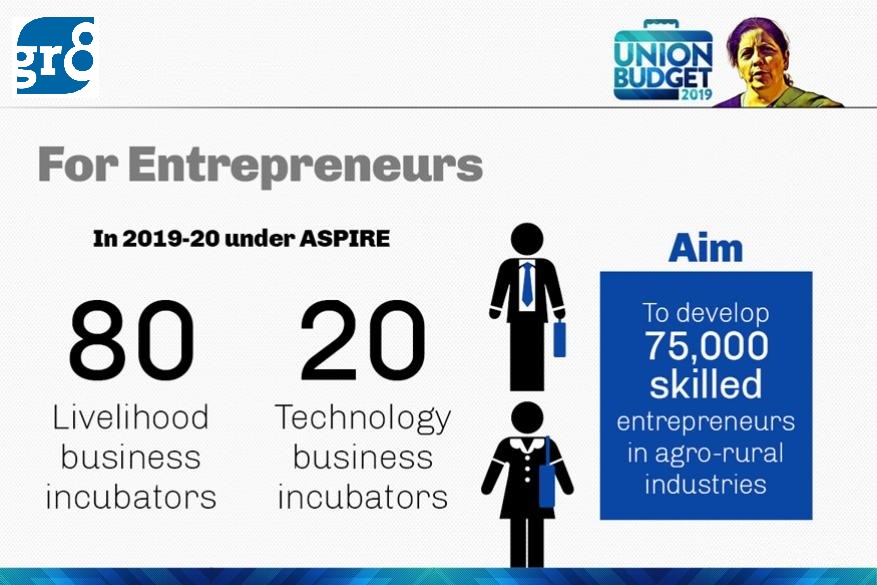
    Friends, we already gave you the Complete Highlights of Union Budget 2019 in PDF Format. Today we are giving you the major highlights of Union Budget in pictorial form. It will be easier for you to get the concept and numbers in a quick glance. You can download pdf version fo these images from the link given at the end of the post. Good Day :)

    Quick Review of Union Budget 2019 (The Big Picture)


    sponsored links

    Read More...

    July 05, 2019

    Union Budget 2019 : Complete List of items that got Cheaper and Costlier

    Leave a Comment
    Finance Minister Nirmala Sitaraman in her maiden budget announced a change in custom duty of several products. This move will lead to a big change in their market prices. Among the key announcements of the Union Budget 2019-20 are increase in the import duty on gold, rise in the excise duty on petrol and diesel, hike in customs duty on mobile phones, etc. Gr8AmbitionZ team has complied a list of items that are set to get cheaper and dearer after the budget comes into effect. Have a look.

    List of things that will become Costlier and Cheaper after Union Budget 2019

    Cheaper items in Union Budget 2019

    • Amorphous alloy ribbon
    • Camera module of cellular mobile phones
    • Charger/Adapter of cellular mobile phone
    • Cobalt mattes
    • Cold-rolled MgO coated and annealed steel
    • Compact Camera Module
    • Display Module
    • Germanium Tetra Chloride
    • Hot rolled annealed and pickled coils
    • Hot rolled coils
    • Lithium Ion Cell
    • Naphtha
    • Populated PCBA
    • Refrigerated Helium Liquid
    • Set Top Box
    • Silica Rods
    • Silica Tubes
    • Silicon Tetra Chloride
    • Steel
    • Textile
    • Wool fibre, Wool Tops 

    Costlier Items in Union Budget 2019

    Due to Custom Duty

    • Base metal fittings, mountings and similar articles suitable for furniture, doors, staircases, windows, blinds, hinge for auto mobiles
    • Cashew
    • Catalytic Converter
    • CCTV camera and IP camera
    • Ceramic products
    • Ceramic roofing tiles
    • Charger/ power adapter of CCTV camera/ IP camera and DVR / NVR
    • Chemicals
    • Digital Video Recorder (DVR) and Network Video Recorder (NVR)
    • Floor cover of plastics
    • Glass mirrors
    • Gold (including gold plated with platinum) unwrought or in semi-manufactured forms, or in powder form
    • Gold dore bar, having gold content not exceeding 95%
    • Indoor and outdoor unit of split system air conditioner
    • Lighting or visual signaling equipment of a kind used in bicycles or motor vehicles
    • Lightweight coated paper used for magazines
    • Loudspeaker
    • Marble slabs
    • Motor spirit commonly known as petrol, High speed diesel oil
    • Newsprint
    • Optical Fibres
    • Other lamps for automobiles.
    • Other visual or sound signalling equipment for bicycle and motor vehicle
    • Petroleum crude
    • Plastics
    • Platinum, unwrought or in semi-manufactured forms, or in powder form
    • Precious metal compounds
    • Printed books (including covers for printed books)
    • Printed manuals
    • Rearview mirrors
    • Rubber
    • Sealed beam lamp units
    • Silver (including silver plated with gold or platinum) unwrought or in semimanufactured forms, or in powder form
    • Stainless steel products
    • Steel and base metal products
    • Uncoated paper used for printing of newspapers
    • Wall or ceiling coverings of plastics
    • Waste and scrap of precious metals or of metal clad with precious metals; other waste and scrap containing
    • Water blocking tapes for manufacture of optical fiber cables
    • Windscreen wipers, defrosters and demisters

    Due to Excise Duty

    • Chewing tobacco
    • Cigarettes
    • Biris
    • Diesel
    • Hookah or gudaku tobacco
    • Jarda scented tobacco
    • Petrol
    • Petroleum crude
    • Smoking mixtures for pipes and cigarettes


    sponsored links
    Read More...
    Related Posts Plugin for WordPress, Blogger...